Bug of the Month The Amazing Leafcutter Bee (Megachilidae)
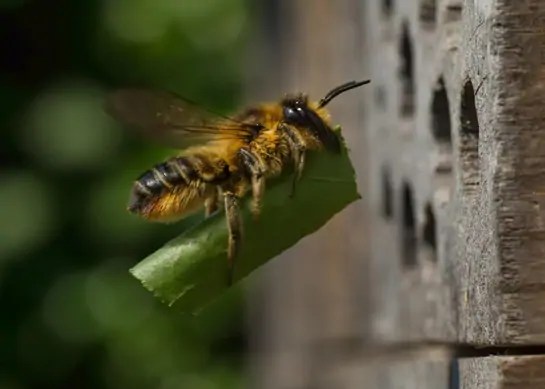
Today we are talking about the Leafcutting Bee, scientifically known as Megachile Latreille. Their nickname explains exactly what they do: they cut leaves! The female leafcutting bee is responsible for building a “nursery” for her little larvae. She finds a suitable space in preexisting tubular cavities (basically: holes). These cavities could be in hollow stems, rotting wood, empty tunnels left by beetles, snail shells and even man made holes in buildings! This is a fantastic example of reusing material; humans could learn a thing or two from these bees. Once the female bee finds a cavity that is long and wide enough, she begins to carefully line the hole with leaves and petals to create a nice and comfortable brood chamber (this is the nursery). When she finishes one chamber she will lay her egg and provide pollen for the larva to eat. Each chamber is home to one egg which means the female leafcutting bee is constantly adding chambers until the hole is filled. Each chamber is separated by a wall made up of chewed leaves and mixed with resin. When the baby bees mature they are thankful for the home their mother has created and they stay the winter in their cozy chambers. When the spring arrives the adult bees chew their way through the chambers and exit the nest.

Leaf cutter bees remain close to home collecting pollen and nectar within 100 metres or so of their nest. This makes them a popular addition to flower gardens and backyard spaces. Pollen is carried on their hairy abdomen and then deposited inside the nesting holes. Small bits of pollen fall off these hairs as they forage among flowers resulting in effective cross pollination. Leafcutter bees are very efficient pollinators of many varieties of flowers. They can forage on even the tiniest of flowers such as catmint or lavender. In flower gardens rose bushes and pansies are readily cut for nesting material. In a commercial setting leafcutter bees are used to pollinate alfalfa, carrots, other vegetables and some fruits like wild blueberries. A tenfold increase in the pollination of alfalfa flowers is noticed when leafcutter bees are distributed into our fields.

The Lifecycle of Leafcutter Bees
Leafcutter bees mate shortly after emerging in the spring. The males live for a short period of time after mating, whereas the females seek out potential nesting sites. As solitary bees, leafcutter bees don’t live in colonies with a queen. Each bee builds her own nest and raises brood on her own.
Starting in late spring and into late summer, the leafcutter bee builds her nest in wood cavities, typically rotten wood, or in tunnels carved into hollow stems, empty snail shells, dry soil, or holes in concrete walls and other man-made objects.
Depending on the species—the members of the Megachile family vary in size—the cavity can be smaller or larger but on average it’s about the diameter of a pencil.
To build the nest, the female bee chews ¼- to ½- inch circular pieces from leaves or petals which she layers into the shape of a thimble for each cell. A typical nest consists of up to 20 of these cells, packed tightly together. The female then begins the process of collecting nectar and honey which she mixes with her own saliva to create food for her larvae. After placing food in each cell, she lays a single egg in each one. The final task in her life cycle is to close each cell with a seal made of chewed up leaves.
When the larvae emerge, they feed on the food in the nest and pupate over winter. In spring, the new generation of adult bees chew their way out of the nest and the life cycle begins anew.
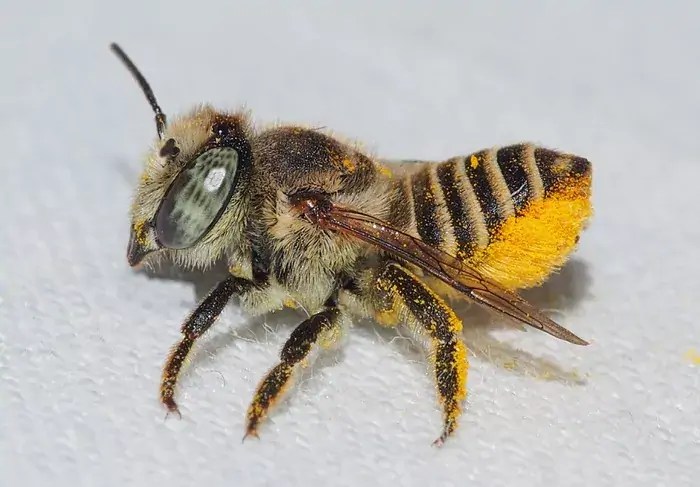
How do you identify these bees? Leafcutters are similar in size to honeybees. The females are larger than the males and have a triangular shaped abdomen that ends in a point. The males can be identified by their smaller, blunt pointed abdomens and their long antennae. The leafcutter has a larger head than most bees due to extra muscles they have developed to help them chew through leaves. The females even have teeth

An interesting difference between leafcutters and honeybees is the way the two transport pollen. Honeybees have unique pollen “baskets” on their rear legs for collecting and carrying pollen. The leafcutter bee has special hairlike structures on the underside of her abdomen used for transporting pollen. The underside of the bee might appear yellow or golden, but look closely and you might see this is actually pollen.